
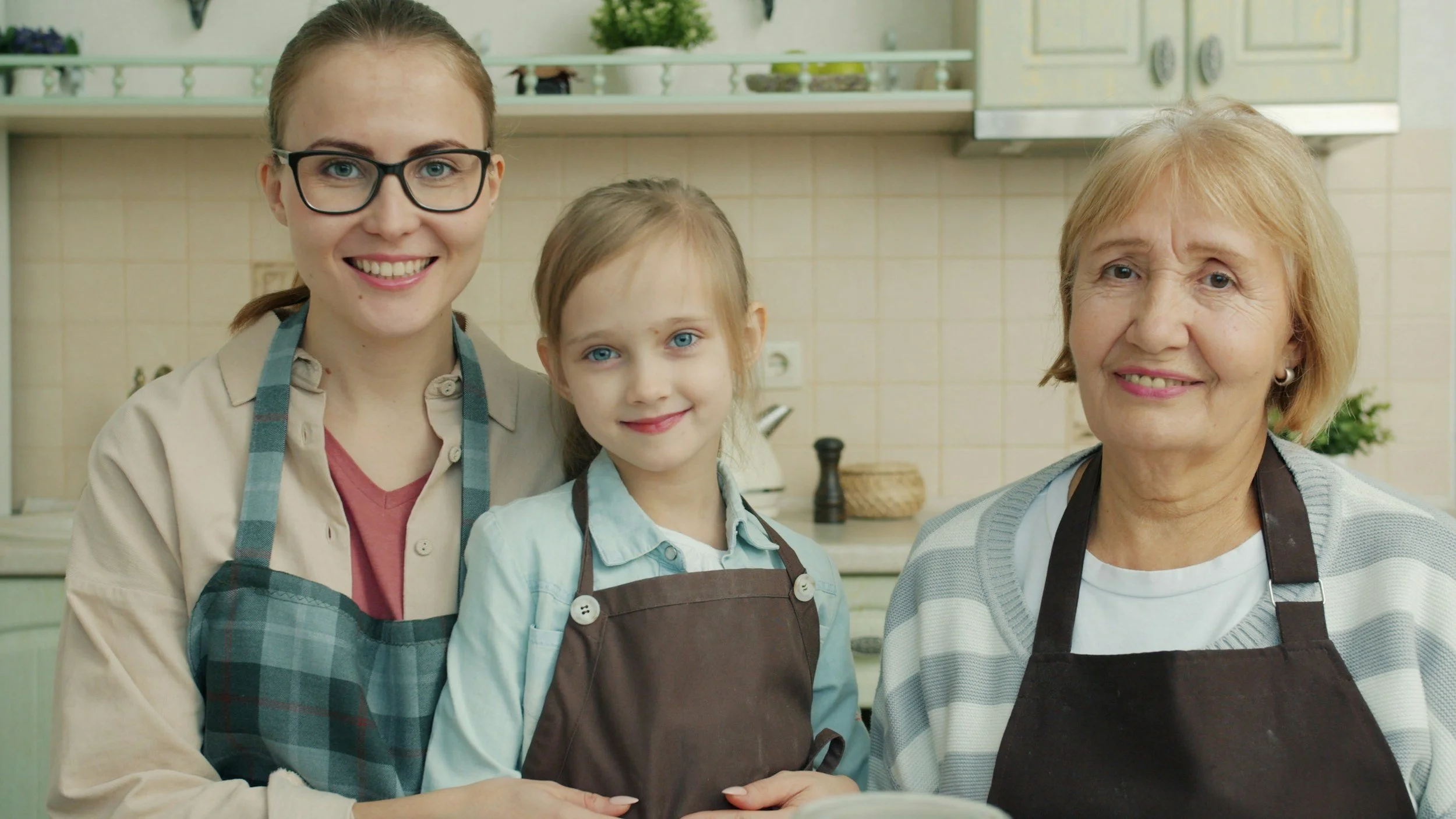
You swore you would never do it. And then one day you hear it coming out of your own mouth: the same sigh, the same phrase, the same way of going silent when you are upset. Suddenly you are not you anymore. You are your mom in 1997, standing in a kitchen, very annoyed about the dishwasher.
Family patterns are sneaky like that. They get passed down without anyone sitting you down to explain them, and they tend to show up loudest when the whole family is in one room, which is to say, around a Thanksgiving table. In this post we will look at how these patterns form, which ones most commonly travel through generations, why the holidays turn up the volume, and what you can actually do to rewrite your part of the script.
Why Families Feel Like They Have a Script
Every family is a small system with its own rules, roles, and rhythms. Most of those rules are never said out loud. Nobody announces "we don't talk about feelings here" or "Dad's mood determines the day." Everyone just learns it, the same way you learn a language by growing up around it.
That is not necessarily bad. Families need structure, and plenty of inherited patterns are lovely: a sense of humor, a tradition of showing up, a knack for making people feel fed. The trouble is that the less helpful patterns get passed along just as efficiently as the good ones. And because you learned them before you had words, they often feel less like choices and more like simply "how things are."
The Patterns That Tend to Get Handed Down
Family patterns come in endless varieties, but a few show up again and again. See if any of these feel familiar.
Conflict Styles
Some families yell. Some freeze each other out for days. Some pretend nothing is wrong until it all explodes over the gravy. Whatever the style, kids tend to absorb it as the default template for what disagreement looks like, and then carry it into friendships, jobs, and romantic relationships.
The tricky part is that your conflict style probably feels like the normal one. It is only when you partner with someone from a door-slamming family (or a nobody-raises-their-voice family) that you realize there were other options all along.
Family Roles
The responsible one. The peacemaker. The funny one. The "difficult" one. Roles often form to keep a family system stable, especially under stress. They can stick for decades, which is why a competent adult can walk into their parents' house and instantly feel fourteen.
Roles are not just assigned by parents, either. Siblings reinforce them, extended family comments on them, and you probably learned to play yours so well that stepping out of it feels disloyal. That discomfort is not proof you are doing something wrong. It is just the system noticing a change.
Unspoken Rules About Feelings
Maybe anger was not allowed, but sadness was. Maybe everyone was expected to be "fine." Maybe emotions were only acceptable if they were about someone else. These rules shape what you let yourself feel, and what you assume other people can handle.
If you grew up being the family's emotional thermostat, you may have become an expert at reading everyone else's feelings while losing track of your own. That is a pattern worth noticing, gently.
How Love Gets Shown
In some families, love sounds like "I love you." In others, it looks like a packed lunch, a fixed car, or relentless teasing. Neither is wrong, but mismatches can cause real hurt when someone expects love in a language their family never spoke.
Recognizing a pattern is not the same as blaming anyone for it. Most of these were handed to your family long before they were handed to you.
How Patterns Travel From One Generation to the Next
Patterns do not pass down through a single mechanism. They move through modeling (kids copy what they see), through survival (kids adapt to what keeps them safe and connected), and through beliefs about themselves that get absorbed along the way. If a parent was critical, you might have internalized that voice so completely that it now sounds like your own. We dig into that in building self-esteem after internalizing every criticism.
Patterns also show up in who we are drawn to. Many people find themselves recreating familiar family dynamics with partners, sometimes without realizing it until the third or fourth time. If that rings a bell, read why you pick the same type of partner. And often, the behaviors we most want to change started as protection. The perfectionism, the people pleasing, the shutting down: all of it made sense once. Here is more on why the part that sabotages is actually protecting you.
Thanksgiving: Where Old Patterns Show Up Hungry
The holidays are basically a pressure cooker for family patterns. You are back in the old house, surrounded by the old roles, often short on sleep and long on expectations. Everyone is trying to have a nice time, and everyone is also slipping back into the parts they have been playing for years. It is no wonder so many people come home from Thanksgiving feeling wrung out.
For LGBTQ+ folks, neurodivergent people, and anyone whose identity was not fully welcomed at home, gatherings can carry an extra layer of vigilance. You might be deciding in real time how much of yourself to show. That is exhausting, and it is valid to plan for it rather than just white-knuckle your way through. And if home is not safe, or you have chosen distance from family, skipping the gathering (or spending it with chosen family) is a legitimate choice. Gratitude is a lovely theme this time of year, and it can sit right alongside honesty about what is hard.
Practical Ways to Rewrite Your Part
You cannot change your whole family, and you do not have to. Changing even one person's part in a system tends to ripple outward. Here are some places to start, whether you are heading into a holiday or just trying to stop hearing your dad in your own voice.
1. Get Curious About the Pattern
Before trying to change a pattern, try noticing it with curiosity instead of judgment. When did you first learn this? Who else in the family does it? What was it protecting? Curiosity creates a little space between you and the pattern, and that space is where choice lives.
It can help to sketch a simple family map on paper: who is close, who clashes, who plays which role. Seeing it laid out visually often reveals things that talking in circles never quite does.
2. Notice When the Old Voice Takes Over
Inherited patterns often show up as an inner voice that sounds suspiciously like a relative. Learning to recognize it, and respond instead of obey, is a skill. Our guide on how to tell your inner critic to sit down is a good place to practice.
3. Practice a Different Move in Low-Stakes Moments
Do not wait for Thanksgiving dinner to try something new. Practice with small things: saying no to a minor request, stating a preference, letting a silence sit. DBT skills like DEAR MAN can give you a structure for asking for what you need; find more in the DBT acronyms that sound ridiculous but work.
4. Stay Present When It Gets Loud
When a familiar dynamic kicks off, your body may react before your brain catches up. Simple grounding (feeling your feet, noticing your breath, naming five things you can see) can help you stay in the room as the adult you are now. If sitting still to meditate is not your thing, try some of these ideas on mindfulness for people who hate meditation.
5. Give Yourself an Exit Plan
Boundaries are not about controlling other people; they are about deciding what you will do. That might mean driving yourself so you can leave, taking a walk halfway through dinner, or having a friend on standby for a debrief text. An exit plan is not rude. It is care.
It also helps to decide ahead of time which topics you will engage with and which ones get a polite, rehearsed redirect. "I'm not going to get into that today, but how's the new puppy?" is a complete sentence.
Pick one or two of these rather than all five. Small, consistent changes stick better than a dramatic overhaul.
You Can Keep the Recipes and Change the Script
Family patterns are powerful because they were learned early and practiced often. But they are learned, which means new patterns can be learned too. You get to keep what nourishes you (the stuffing recipe, the inside jokes, the way your family shows up in a crisis) and gently set down what does not.
Therapy can help you untangle which patterns are yours to keep, and working on them before they spill into your closest relationships is smart, not dramatic. As we say about partnerships, couples therapy is preventive medicine, not CPR, and the same logic applies to family patterns. At START Creative Arts Therapy, we blend creative arts therapies with approaches like CBT, DBT, IFS, and EMDR, always with LGBTQ+ affirming and neurodiversity-affirming care. If this is the year you want to start rewriting your part of the family script, reach out to schedule a consultation.