
START CREATIVE ARTS THERAPY SERVICES
Group Art Therapy in West Islip, Long Island, NY
You don't have to talk about it. You can paint it, move it, and heal it together.
Here's the thing nobody tells you about struggling: it's incredibly isolating.
And honestly? We get it.
You sit with your anxiety, your grief, your overwhelm, and you convince yourself you're the only one. That no one else actually gets it. So you pull back. You cancel plans. You doom-scroll instead of reaching out.
And the loneliness compounds everything you were already carrying. Sound familiar? Yeah. We get it.
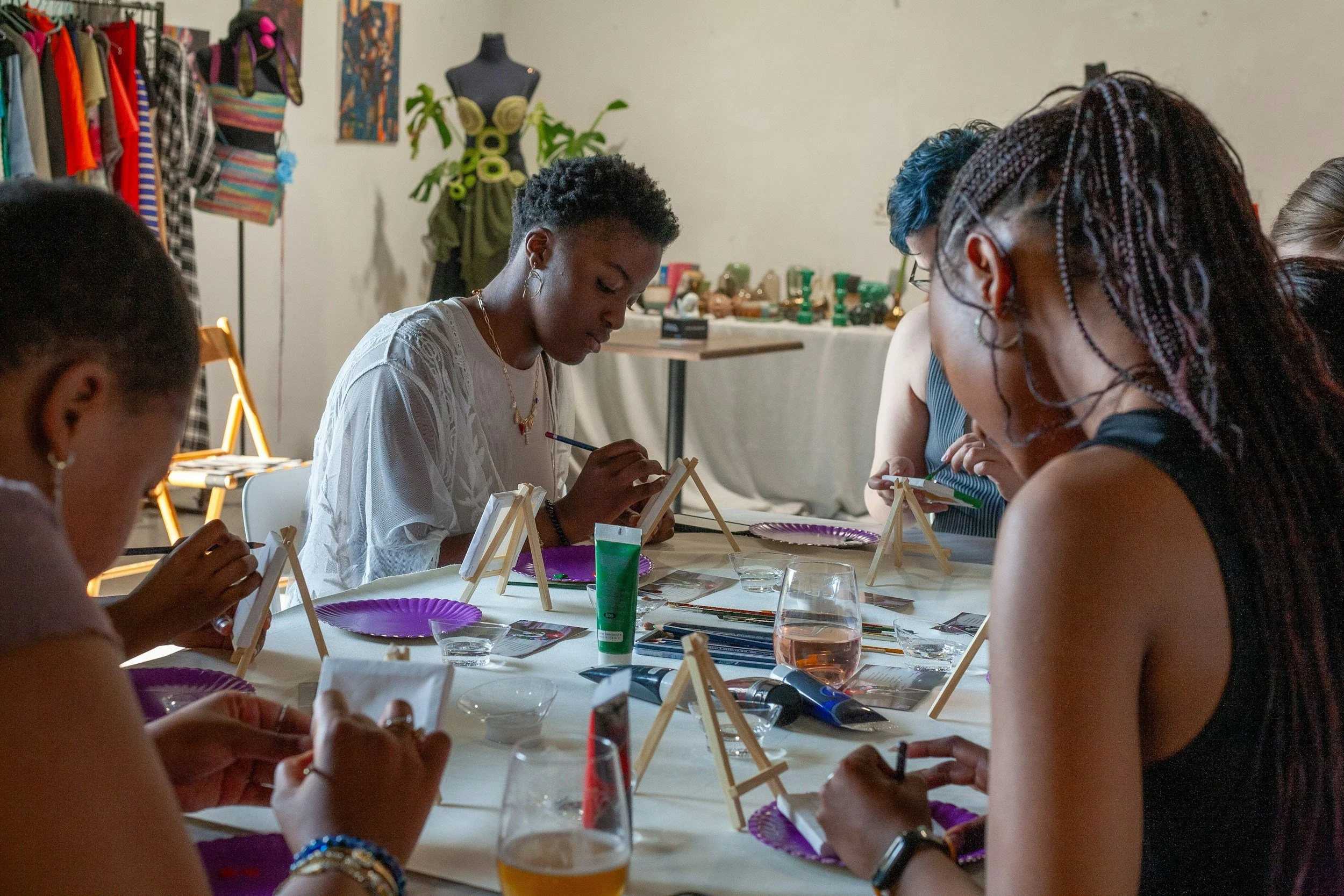
Group art therapy at START Creative Arts Therapy flips that script entirely. Instead of sitting across from a therapist searching for the "right" words, you sit alongside others who are navigating their own versions of the same storm, and you make something together. You paint what you can't say. You collage what you can't explain. You sculpt what's been sitting in your chest for months. The art becomes the conversation, and suddenly the pressure to perform or overshare disappears. What shows up instead is raw, honest, and surprisingly freeing. This isn't arts and crafts hour. This is real therapeutic work facilitated by licensed creative arts therapists who know exactly how to hold space for a room full of humans doing brave things.
And here on Long Island, where the pace is relentless and the expectation to "keep it together" is baked into the culture, having a space where you can drop the mask matters more than you think. Our West Islip studio is designed to feel like a creative sanctuary, not a waiting room. Whether you walk through our doors at 248 Higbie Lane or join virtually from anywhere in New York State, you're stepping into a community that actually sees you. No judgment. No pressure. Just people healing out loud, together.
What is Group Art Therapy?
Group art therapy is a structured therapeutic experience where a small number of participants come together under the guidance of a licensed creative arts therapist to explore emotions, process experiences, and build coping skills through artistic expression.
Unlike traditional talk-based group therapy, the creative process itself becomes the primary vehicle for communication and healing. You don't need to be an artist. You don't need to know what you're feeling before you walk in. The materials, paint, clay, fabric, collage, ink, whatever calls to you, help you access what words alone often can't reach.
At START, our group sessions follow a thoughtful, trauma-informed framework. Each session typically begins with a brief grounding exercise to settle the nervous system, followed by a guided creative prompt designed by your facilitator around that group's theme or focus. You create. You share, if and when you want to. Your therapist helps the group make meaning from what emerges, drawing connections between the art, the body's responses, and the lived experiences in the room. Some groups are theme-based, centering on specific challenges like grief, anxiety, women's identity, or mood regulation. Others are more open, welcoming anyone who needs a creative outlet and community support. Sessions may run as ongoing weekly groups or as limited-series workshops and community events.
The outcomes are tangible and often surprising. Participants consistently report decreased feelings of isolation, improved emotional vocabulary, stronger coping mechanisms, and a sense of belonging they hadn't experienced in traditional therapeutic settings. There's something profoundly normalizing about watching someone across the table paint the exact shade of heaviness you've been carrying. That moment of recognition, I'm not the only one, is where the real healing begins.
Our groups are facilitated exclusively by Licensed Creative Arts Therapists on staff at START, all trained in trauma-informed, person-centered, and strengths-based approaches. Whether you join us in person at our West Islip studio or connect through our telehealth platform from anywhere in New York, you'll receive the same level of clinical expertise and creative intentionality that defines everything we do.
Heal Out Loud | Join a Group Session
How Group Art Therapy Benefits You
Creative arts therapy offers unique benefits that traditional talk therapy alone may not provide:
-
Let's be honest: talking about your feelings in front of strangers sounds like a nightmare for most people. The pressure to articulate exactly what's wrong, to sound coherent when you're falling apart inside, to not cry "too much" or say "the wrong thing", it's enough to keep you from ever walking through the door. Group art therapy removes that barrier entirely. The creative process becomes your voice. A smear of red paint can say more about your anger than twenty minutes of trying to explain it. A torn collage can express fragmentation in ways language simply can't.
This is especially meaningful for Long Islanders who've been conditioned to power through discomfort, to perform functionality even when everything underneath is unraveling. In our West Islip groups, we see it all the time, someone picks up a brush expecting nothing, and forty-five minutes later they're staring at a piece of art that tells a story they didn't even know they needed to tell. The group witnesses it. The therapist holds space for it. And nobody asks you to explain yourself unless you want to.
The result? People who've felt stuck in traditional talk therapy suddenly find movement. People who thought they "weren't therapy people" discover they absolutely are, they just needed a different language. Creative expression bypasses the overthinking, the intellectualizing, the defenses your brain has built to keep you safe. It goes straight to the thing. And in a group setting, that shared vulnerability creates bonds that are hard to replicate anywhere else. You leave not just with insight, you leave with connection.
-
Mental health challenges thrive in isolation. Anxiety tells you everyone's judging you. Depression tells you no one cares. Grief tells you nobody understands. And slowly, you build walls that feel protective but are actually prisons. Group art therapy dismantles those walls, not by forcing vulnerability, but by placing you in a room (physical or virtual) with people who are quietly fighting the same battles. You don't have to share your story. You just have to show up and create alongside others who are also showing up.
On Long Island, where community can feel surface-level, PTA meetings, neighborhood barbecues, and social media highlight reels, finding a space where people are genuinely honest about their struggles is rare and powerful. Our groups at START intentionally cultivate that authenticity. The creative process naturally lowers defenses. When everyone's focused on their art, the usual social performance drops away. What's left is real. People laugh together. People cry together. People sit in comfortable silence together while their hands do the talking.
Research consistently supports what we see in our studio every week: group therapy reduces feelings of isolation, increases social connectedness, and provides a sense of belonging that individual therapy alone can't always deliver. When you witness someone else's pain reflected in their artwork and realize it mirrors your own, something shifts. You stop feeling like the only broken one in a sea of people who have it together. Because here's the truth, nobody has it together. And that shared acknowledgment? That's where community begins. Our groups across Long Island and virtually throughout New York State are building exactly this kind of real, messy, beautiful community.
-
We need to say this clearly: group art therapy is not a paint-and-sip night. It's not a craft workshop. It's not "coloring for stress relief." It is a clinically grounded, evidence-based therapeutic modality facilitated by licensed professionals who hold master's degrees and have undergone rigorous training in both psychotherapy and creative arts. Every group session at START is led by a Licensed Creative Arts Therapist who understands group dynamics, trauma responses, attachment patterns, and how to create psychological safety in a shared space.
This distinction matters because the therapeutic container is what makes group art therapy transformative rather than just pleasant. Your facilitator is tracking the room, noticing who's withdrawn, who's activated, who's dissociating through perfectionism in their art. They're making clinical decisions in real time about when to invite deeper exploration, when to redirect, and when to simply let the group hold itself. They're trained in trauma-informed, person-centered, and strengths-based approaches, ensuring that the experience is safe for everyone present, regardless of where they are in their healing journey.
At START, our team of over thirty staff members includes therapists specializing across modalities, art, music, dance and movement, drama, and writing therapy, as well as EMDR, CBT, solution-focused therapy, and somatic approaches. This means your group facilitator isn't working in a silo. They're part of a collaborative clinical team led by founder Dina Palma, LCAT, who built this practice on the conviction that creativity isn't a nice-to-have in therapy; it's the whole language of healing. When you join a group at START, you're getting the full weight of that clinical depth behind every session. That's the difference between an art class and art therapy. And it's a difference that changes lives.
-
One of the most powerful aspects of group art therapy at START is that our groups aren't generic. We design themed sessions and series that speak directly to what our community is navigating, grief and loss, anxiety, women's identity and empowerment, mood regulation, postpartum challenges, LGBTQIA+ experiences, and more. When you join a themed group, you're not just surrounded by people who like art. You're surrounded by people who understand your specific struggle because they're living their own version of it.
This targeted approach means the creative prompts, the therapeutic interventions, and the group discussions are all calibrated to the shared experience in the room. A grief group might work with memory collage and symbolic object-making. An anxiety-focused group might explore body mapping and grounding through texture. A group centered on identity might use mask-making or self-portraiture as vehicles for exploration. The specificity creates depth that open-format groups sometimes can't reach.
For our Long Island community, where there's often pressure to present a curated version of yourself, themed groups offer rare permission to be exactly where you are with people who won't flinch. Our community workshops and special events extend this even further, providing accessible entry points for people who aren't sure they're ready for ongoing therapy but know they need something. Whether it's a single workshop or a multi-week series, every themed experience at START is designed to meet you where you are and give you tools you can actually use when you leave the room.
-
Not everyone can make it to West Islip. Maybe you're across Long Island. Maybe you're upstate. Maybe you're in the city and the LIRR commute feels like one more barrier between you and getting help. We hear you. START offers virtual group art therapy sessions accessible from anywhere in New York State, and we want to be really clear about something: online groups are not a lesser version of in-person groups. They are full, facilitated, clinically grounded therapeutic experiences.
Our telehealth groups are designed with the same intentionality as our in-person sessions. Your therapist provides material suggestions in advance so you're prepared to create during the session. The virtual format actually offers some unique advantages. Participants often feel safer being vulnerable from the comfort of their own space, and the accessibility means we can bring together people from across the state who might never have connected otherwise. For parents who can't get a sitter, for folks with mobility challenges, for anyone whose anxiety makes leaving the house feel impossible on certain days, virtual group therapy isn't a compromise. It's a doorway.
We serve communities across Suffolk County, Nassau County, New York City, Westchester, and beyond. The geographic diversity in our virtual groups adds richness to the experience, different perspectives, different contexts, and same humanity. If you've been putting off group therapy because of logistics, distance, or the sheer energy it takes to get somewhere, this is your sign. You can do this from your couch, your bedroom, your parked car in the school pickup line. We don't care where you are. We care that you're there.
-
Here's something people don't always admit: individual therapy can feel like a lot of pressure. It's just you and a therapist, the spotlight is on, and you're supposed to have something to talk about for fifty minutes. Some weeks you do. Some weeks you sit there wondering if you're "doing it right." Group art therapy shifts that dynamic entirely. The focus is distributed. The art carries the weight. And you get to witness other people's processes, which often illuminates your own in ways that being alone in a room never could.
For people who are new to therapy, group sessions can be a gentler entry point. You get exposure to therapeutic concepts, coping strategies, and emotional processing without the intensity of one-on-one work. For people already in individual therapy, group work adds a dimension that deepens everything, the communal witness, the peer reflection, the realization that your therapist isn't the only person on your team. And for people who tried individual therapy and decided it "wasn't for them," group art therapy often reveals that it wasn't therapy they had a problem with, it was the format.
At START, we believe healing isn't one-size-fits-all. Some people thrive in individual sessions. Some people need the energy of a group. Many people benefit from both. Our clinical team can help you figure out what combination of services serves you best, whether that's group art therapy alone, paired with individual sessions, or integrated with other modalities like EMDR or dance and movement therapy. The point is: there's no wrong way to start. And sometimes the lowest-stakes option leads to the biggest breakthroughs.
Our Services
Group Art Therapy Sessions
Facilitated group experiences where participants explore emotions, process trauma, and build coping skills through guided art-making. Led by LCATs in a safe, structured environment. Available in-person at our West Islip studio and virtually across New York State. No artistic skill required, the process is the point.
Community Workshops and Events
Accessible, often single-session creative experiences designed for people curious about art therapy or looking for community connection without committing to ongoing treatment. Themed workshops address topics like stress relief, self-expression, grief, and identity exploration. A welcoming entry point for anyone who wants to experience creative healing in a low-pressure group setting on Long Island and beyond.
Virtual Group Therapy
Full clinical group art therapy sessions are conducted via a secure telehealth platform for participants anywhere in New York State. Material lists provided in advance. Same therapeutic structure, same licensed facilitators, same community connection, from wherever you are. Ideal for those with scheduling constraints, mobility challenges, or geographic distance from our West Islip location.
Themed Therapeutic Groups
Multi-week group series organized around specific challenges, including anxiety, grief and loss, mood regulation, LGBTQIA+ identity, postpartum mental health, and women's empowerment. Participants share a common focus area, creating a deeper connection and more targeted therapeutic interventions. Groups run on a scheduled cycle with limited enrollment to maintain intimacy and safety.
Integrated Creative Arts Modalities
Beyond visual art, START groups may incorporate elements of music, movement, drama, and writing therapy depending on the group's focus and facilitator expertise. This integrative approach ensures each participant has multiple pathways to expression, meeting a wider range of communication styles and therapeutic needs within the group setting.
Our Process
STEP ONE
Reach Out | And Find Your Group
It starts with a conversation. Contact us at (631) 867-2501 or email support@startcreativearts.com and let us know you're interested in group art therapy. Our team will ask a few questions about what you're looking for, whether that's a specific theme like grief or anxiety, a preference for in-person or virtual, and your general availability. We'll help match you to a group that fits. If we don't have a current group that aligns with your needs, we'll let you know what's coming up and can discuss individual therapy or other options in the meantime. This initial step typically takes one brief phone call or email exchange: no commitment required, just curiosity.
STEP TWO
Verify Your Insurance | And Handle the Details
Before your first session, we'll help you navigate the logistics. START is in-network with CIGNA and Health First, and our team will guide you through verifying your benefits so there are no surprises. We'll also walk you through intake paperwork, which you can complete online at your own pace. If you're joining a virtual group, we'll send you a materials list, basic, affordable art supplies you likely already have at home. For in-person groups at our West Islip studio, all materials are provided. This step usually takes a few days and ensures you can walk into your first session focused on the experience, not the admin.
STEP THREE
Show Up and Create | No Experience Required
Your first group session is designed to feel welcoming, not intimidating. Your facilitator will guide the group through a grounding exercise to help you settle in, introduce the session's creative prompt, and create a space where making art feels natural, regardless of your skill level. You'll create alongside others, and at the end, there's an optional sharing component; you're never pressured to explain your work or your feelings. Your therapist is there to facilitate connection, offer gentle reflection, and hold the therapeutic frame. Most participants say they felt nervous before and relieved after. That's normal. That's the work beginning. Sessions typically run 60-90 minutes, depending on the group format.
STEP FOUR
Build Your Practice | And Your Community
Group art therapy isn't a one-and-done experience. The magic builds over time as trust deepens, creative risks increase, and the group develops its own rhythm and language. Whether you're in a time-limited series or an ongoing open group, each session layers on the last. Many of our participants find that group work sparks interest in exploring individual therapy, EMDR, or other modalities at START, and our clinical team is here to support that evolution. Your healing journey is yours to design, and we'll be alongside you every step, helping you figure out what combination of support serves you best as you grow.
Our Approach
At START, we don't believe healing is something that happens to you.
It's something that happens through you, through your hands, your body, your voice, your willingness to show up even when it's hard.
Our approach to group art therapy is rooted in the conviction that creativity is not a luxury or a supplement to "real" therapy. It is the therapy. Every prompt, every material choice, every moment of shared silence in a group session is clinically intentional, designed to help you access parts of yourself that conventional talk therapy might never reach.
We're trauma-informed, person-centered, and strengths-based, which is our fancy way of saying we meet you exactly where you are and build from what's already strong in you, not from what's broken.
Our methodology integrates multiple creative arts modalities, visual art, movement, music, drama, and writing, because human beings are not one-dimensional, and neither should their therapy be. In a group setting, this integrative approach means that even within a single session, there are multiple expression pathways. If paint doesn't resonate, maybe rhythm will. If words feel too loaded, maybe gesture will unlock something. Our Licensed Creative Arts Therapists are trained to read the room and adapt in real time, ensuring that the group experience remains both clinically rigorous and deeply human. We don't follow a rigid script. We follow the people in the room.
What makes this approach particularly relevant on Long Island, and across New York State, is the cultural weight so many of our clients carry. The pressure to perform, to produce, to have it all figured out. The stigma around asking for help. The isolation masked by busyness. Our groups actively dismantle these patterns by creating an environment where vulnerability is strength, imperfection is welcome, and connection is the whole point. Founded by Dina Palma, LCAT, after two decades in behavioral health, START was built to be the space people actually want to walk into, where the work is deep but the vibe is real. Where you don't have to earn the right to be seen. You just have to show up.
✔ All START therapists are Licensed Creative Arts Therapists (LCATs) or LP-CATs supervised by a licensed therapist in New York State
✔ Founded in 2020; team of 30+ licensed clinicians
✔ In-network with CIGNA and Health First
✔ Serving all of New York State via telehealth
✔ Trauma-informed, person-centered, and neurodiversity-affirming practice
✔ Specializing in creative arts therapy modalities: art, music, dance/movement, drama, and writing therapy
FREQUENTLY ASKED QUESTIONS
Common Questions About Art & Dance Movement Therapy
START Creative Arts Therapy Services has been rewriting the rules of therapy in West Islip, Long Island, since 2020. Founded by Dina Palma, LCAT, with over twenty years of experience in behavioral health, START is a community of 30+ licensed creative arts therapists specializing in restorative treatment for stress, trauma, and anxiety through art, music, dance, drama, writing, EMDR, and more, serving all of New York State in-person and via telehealth.
-
Absolutely not. Group art therapy at START is about the process of creating, not the product. There's no skill requirement, no artistic judgment, and no one critiquing your work. Many of our participants haven't picked up a paintbrush since elementary school. The materials are tools for expression, not performance. Your therapist guides the experience so that creating feels natural and accessible, regardless of your background. If you can hold a crayon, you can do this.
-
Group art therapy is a clinically grounded therapeutic modality facilitated by Licensed Creative Arts Therapists. Unlike a support group, there's a trained therapist actively guiding the process, tracking group dynamics, and making clinical interventions. Unlike an art class, the focus isn't on technique or aesthetics, it's on what the creative process reveals about your emotions, patterns, and experiences. Every session at START is designed with therapeutic goals, not artistic ones. It's therapy that uses art as the language.
-
START is in-network with CIGNA and Health First. We strongly recommend verifying your specific benefits before your first session, as coverage can vary by plan. Our team is happy to help you navigate this, just call us at (631) 867-2501 or email support@startcreativearts.com and we'll walk you through it. We want the financial side handled so you can focus on showing up.
-
Yes. START is licensed to provide telehealth services across all of New York State, and our virtual group art therapy sessions are full therapeutic experiences, not a watered-down version of in-person work. We'll send you a simple materials list ahead of time, and your facilitator will create the same safe, guided space online. Whether you're in Nassau County, New York City, Westchester, or anywhere in NY, you can participate from home.
-
There's no wrong answer here. Some people start with a group because the shared experience and lower pressure feel more accessible. Others begin with individual therapy and add group work later for the community dimension. Many of our clients do both simultaneously. If you're unsure, reach out to us, and we'll help you figure out the best starting point based on what you're dealing with, your comfort level, and your goals. We're here to help you design your own path.
Your People Are Here. Come Create.
Join a group art therapy session at START and discover what healing looks like when you don't have to do it alone.