
How to Create for You, Not for Likes
Be honest. When you finish making something now, what's the first thing you do? For a lot of us, the answer isn't to sit with it, or feel proud of it, or even look at it again. The answer is photograph or film it, post it, and then check back twenty minutes later to see how it's doing. The work isn't finished when it's finished. It's finished when the numbers come in.
That's a quiet kind of heartbreak, and almost nobody talks about it. Somewhere along the way, the algorithm became your studio mate, looking over your shoulder while you work, whispering about what performs and what flops. This is about getting it to leave the room so you can hear yourself think again.
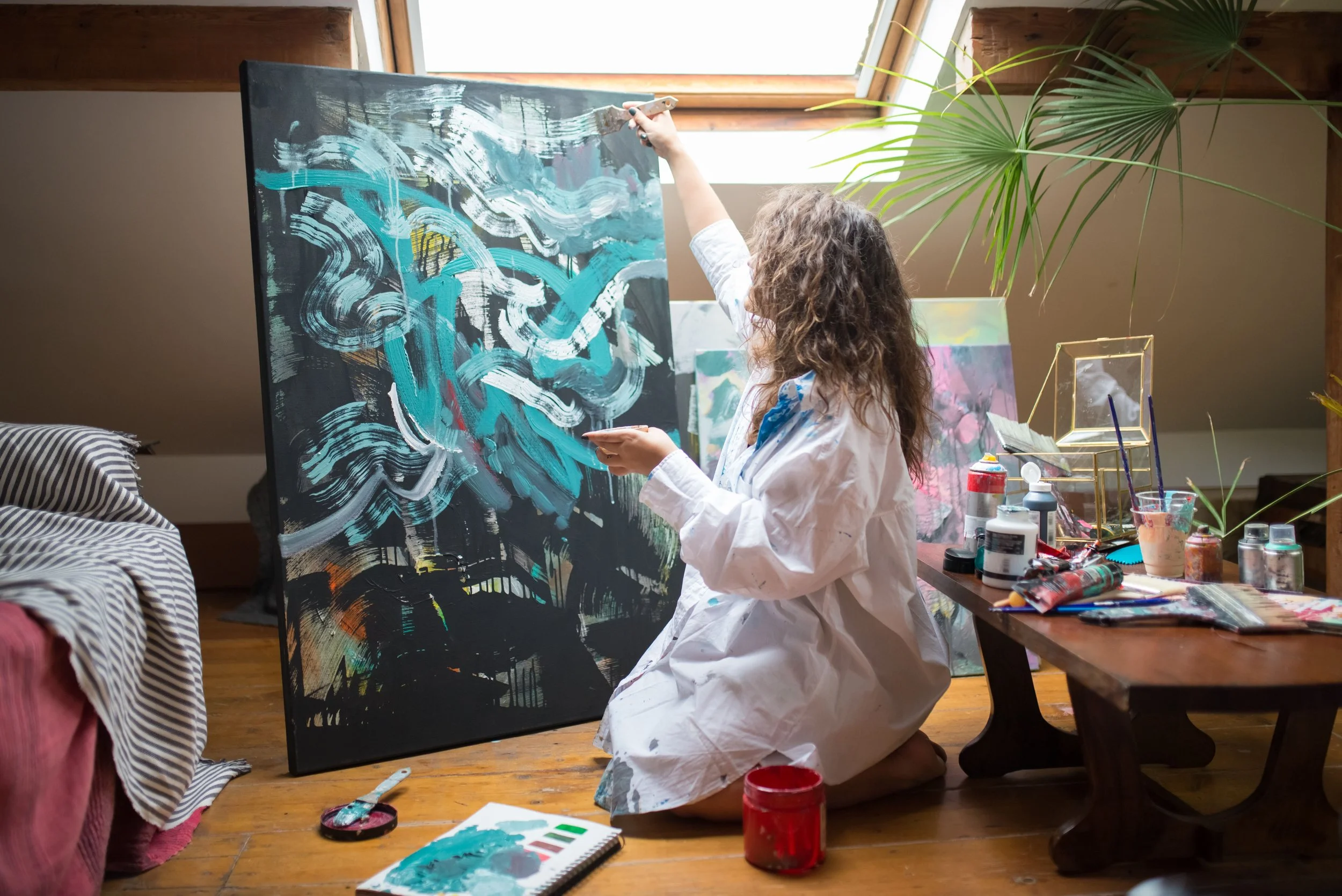
When the Audience Moved Into Your Head
Here's the thing about making for likes: it doesn't start as a choice. It creeps in. You post one thing, it does well, and your brain, which is wired to chase reward, files that away. Next time, without deciding to, you angle slightly toward what worked. Then again. And again. Until one day you realize you can't remember the last time you made something purely because you wanted to see it exist, with no thought to whether anyone else would.
That internalized audience is exhausting. It shows up before you've even started, pre-judging the idea. It's a major driver of creative anxiety, that knot in your stomach before you share, the comparison spiral when someone else's post does better, the strange grief when something you loved gets ignored. The audience in your head has opinions about everything, and none of them are actually yours.
We see this pattern constantly, and we wrote about a version of it in Beyond the Box: Rewriting the Stories That Hold Us Back. The story "my work only counts if people respond to it" is one of the tightest boxes a creative person can live inside. And like any story, it can be rewritten.
What You Actually Lose When You Create for Approval
Making for an audience isn't inherently bad. Sharing work is part of being an artist, and connection is real and good. The problem is when approval becomes the engine instead of a byproduct. Because when that happens, a few things quietly disappear.
The weird stuff: your strangest, most personal ideas rarely test well, so you stop making them. That's exactly where your actual voice lives.
The bad first drafts: you can't be experimental when everything has to be postable. Performance kills play, and play is where discovery happens.
The slow work: things that take months don't fit a content schedule, so you abandon them for quick wins that feed the feed.
The pleasure: making becomes a job interview you're constantly failing or passing, instead of a thing that's good in itself.
The truth: you stop knowing what you actually like, because you've outsourced that judgment to a metric.
None of this happens dramatically. It's a slow leak. And you can patch it.
Remembering How to Make for Yourself
Reclaiming your own creative voice isn't about quitting social media or pretending you don't care what people think. It's about rebuilding a private relationship with your work, the kind that existed before anyone was watching. Our Explore It practice is built on exactly this idea, creating for the sheer joy of the process. Here's how to start finding your way back to it.
1. Make One Thing You Will Never Show Anyone
This is the single most clarifying exercise there is. Make something with a rule: it will never be posted, sold, shown, or mentioned. Watch what happens. You'll likely feel a strange freedom, and maybe some panic, because the performance brain doesn't know what to do without an audience. Sit in that. That's the muscle you're rebuilding.
2. Separate Making From Sharing in Time
Don't photograph the work the second it's done. Let a day pass. Let a week pass. Live with it first. The gap between finishing and sharing is where you get to have your own opinion of the thing before the internet hands you theirs. Protect that gap fiercely.
3. Pay Attention to What You Make When No One Asked
Notice the doodles in the margins, the thing you hum, the way you rearrange a room. The stuff you do without a plan or an audience is a direct line to what you actually find beautiful or interesting. That's your real aesthetic talking, untouched by the algorithm. Follow it.
4. Change Your Definition of a Good Day
If a good creative day is currently defined by engagement, redefine it. A good day is a day you made something true, or learned something, or surprised yourself, or simply showed up. Tie your sense of success to the process, which you control, instead of the response, which you never will.
5. Find People, Not Numbers
There's a difference between an audience and a community. An audience consumes and scores you. A community makes alongside you, witnesses your work, and reflects it back with care. Trade some of your reach for a few real creative relationships. It changes everything.
You don't have to do all five. Pick one. The point is to remember that your work was always allowed to just be yours.
Why This Is Actually a Mental Health Issue
This isn't just an artist problem or a productivity tip. Tying your worth to external validation, watching numbers determine how you feel about yourself, performing instead of expressing, all of that takes a real toll on your nervous system and your sense of self. It's why so much of what we do in art, dance, and movement therapy, and in drama, music, and writing therapy centers on making for the self, with no product required and no one to impress.
When you create without an audience, even something as simple as guided drawing, you reconnect with a part of yourself that exists outside of performance. That reconnection is genuinely regulating. It reminds your body that you are allowed to take up space, make a mark, and have it be enough, just because you made it.
Make the Thing
So here's the invitation. Make something this week that the algorithm would hate. Make it ugly, or slow, or strange, or deeply personal. Make it for the version of you that loved making things before you knew anyone was counting. If you want support reconnecting with your creativity in a deeper way, working with a therapist through a creative lens, or one-on-one in individual therapy, can help you find your way back to the work that's actually yours.
Your art was never supposed to perform for a crowd to matter. It mattered because you made it. When you're ready to make that real again, reach out. We're a whole crew of people who get it.